

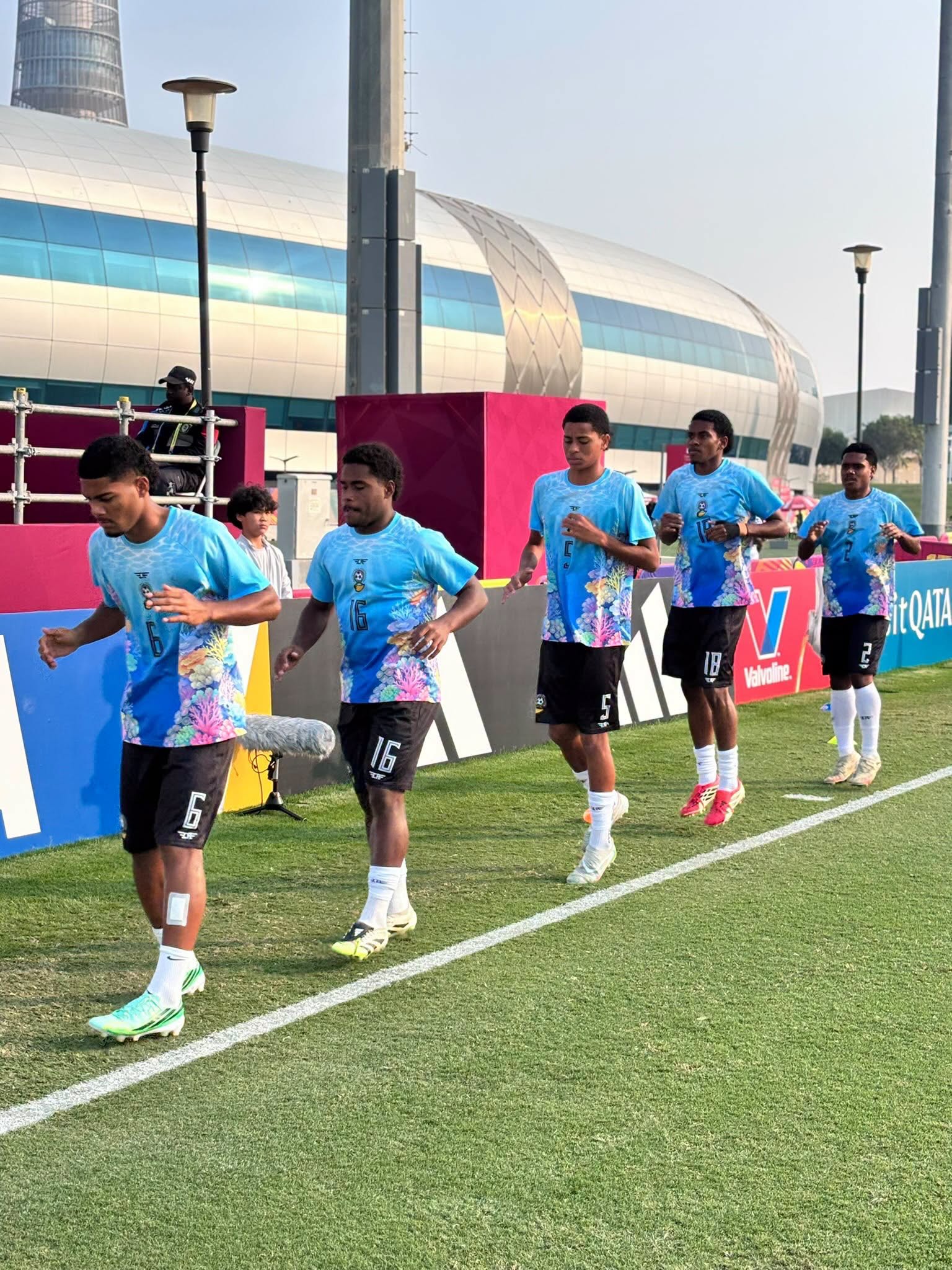
FIJI’S next generation of footballers could benefit from the lessons the young Bula Boys are bringing home from Qatar, says Stéphane Auvray.
The senior national team and Bula FC head coach said the FIFA U-17 World Cup had sharpened the focus on two priorities for Fiji – quality coaching from the age of five or six and regular competitive matches as players grow.
“At the youth level, the scoreline is secondary. What we must focus on is the content. Once we have a concrete youth development program, the players will have the necessary foundation and tools to compete on the world stage,” Auvray said.
“We must focus on the 5-6 year old players and offer them a clear and qualitative 12-year development pathway.
“It is a 10 year plan and it takes time. As the MNT and Bula FC Head Coach I could watch and wait, or help. I choose the second option knowing that until then it would be a rough path.”
Auvray said Fiji Football Association had already taken steps to strengthen that pathway. He pointed to the FIFA Talent Development Scheme, the opportunities opened up by the OFC Pro League and work on a new high-performance centre.
“To be fair, the FA is aware and has been working on closing the gap by joining the TDS, enrolling in the OFC Pro League to create a pathway, and building a new high performance center.”
Asked to outline the association’s long-term plans, Auvray referred the question to Fiji FA’s technical director.
“I leave this answer to our TD,” he said.
The young Bula Boys opened their campaign with a 6-0 loss to Morocco and a 15-0 defeat to Spain. Auvray said playing opponents with years of structured training and regular high-level competition gave Fiji a clearer measure of the work ahead.
“We played the African Champions and World Champions U17 teams. Those players play in the best teams in the world many of them are already professional players,” he said.
“There is a logic in those results and it would be bad faith on our part not to acknowledge that.”
Asked about the Spain match, Auvray said the difference could be traced back to how the players on both sides had developed over several years.
“The assessment must not be made on that one game, but on what led to it,” he said.
“On one side there was a team of professional players who have been developing their skills since the age of 4-5 years old, and on the other side, players who went through no development.
“Additionally the players we face in these competitions play a 10 month season which represents approximately between 30 and 40 high-level matches.
“More than half of our players played between 0 and 10 matches since January 1st 2026, and none was a high-level match.
“Only Maikah Dau played high level matches in the pro league, and it shows.”
Auvray said the physical demands of international football were also part of the challenge.
“It is also important to highlight the athletic aspect of the game. Football is becoming a very physical game with strong athletes.
“Culturally, in Fiji our best athletes tend to choose Rugby, which leaves football with an athletic deficit.”
He said other Oceania teams faced similar challenges when stepping up to World Cup competition.
“Of course! At this time we can compete only in Oceania, and the same goes for New Caledonia who is also currently suffering the same fate. They even lost 16-0 last year.
“The best team in the region, New Zealand is yet to win a game as well.
“It is not only a Fijian assessment.”
Auvray joined the squad shortly before it left for Qatar and shared his observations with the Fiji FA board after three warm-up matches.
“I only offered assistance one week before flying to Doha following the U17 Head Coach’s resignation. As a result I did not partake in the two month preparation camp,” he said.
“We played 3 games before facing Morocco and I made an assessment to the board to emphasize the enormous gap between our players and the international level.”
He said the value of playing at a World Cup was in taking those lessons back into Fiji’s youth programme.
“Today, the exposure is major to raise awareness of the situation. Things will change once the players go through a proper developmental system. Our players are so far not equipped to face high level football.
“Every world cup is an opportunity to have a reality check and make the necessary adjustments.”
Auvray acknowledged the backing from Fijian supporters and said the experience of communicating plans for the senior Bula Boys and Bula FC could help Fiji FA bring fans along as the youth programme develops.
“From what I have seen after spending a year in Fiji, the people are very supportive and realistic about the situation of their football on the international stage.
“I do not believe they are naïve enough to think that we would beat the top teams in Europe, Africa or Asia.
“Since I am just helping out the U17 Team after their coach resigned one week before flying to Qatar, I will take examples that pertain to my functions as a Senior coach.
“Through clear communication on the plan for both MNT and Bula FC, Fijian supporters have an understanding of where we try to go, and how.
“Defining and sharing a clear and concrete youth development plan would help them to better support us and also keeps us accountable.”


